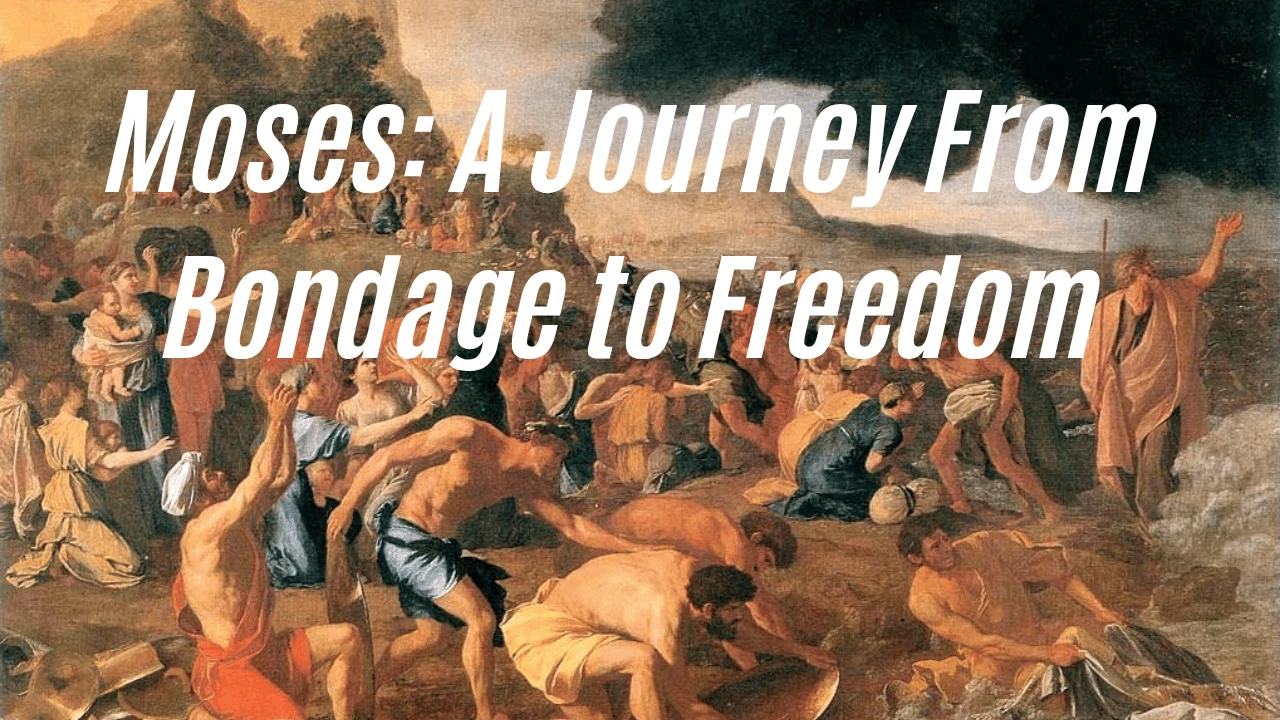
Series: Moses: A Journey From Bondage to Freedom
Songs of Salvation
October 25, 2026 | Peter Rowan
Passage: Exodus 15:1-21
Summary
From the opening rhythms of Genesis to the final songs of Revelation, God's people have always been a singing people. When God rescued Israel from slavery and chaos at the Red Sea, their response was the Song of Moses, a song that honestly named the chaos of their past and future while keeping its gaze fixed on the God who saves. Singing is the natural overflow of a heart that has been saved, bringing the whole self, body, breath, and emotion, into an act of praise. Jesus Himself sang on the night before His crucifixion, echoing this same salvation song. The Bible ends in Revelation with the Song of Moses and the Lamb, a song that points to Jesus as the One who accomplishes the ultimate rescue from sin and death. Whatever chaos you are carrying, the invitation is to bring it into song and trust the God who is greater than all of it.
Transcript
Let me pray again. Lord, I pray that you would teach us through this song that we might be enlivened more and more to be a singing people who delight to give you praise not only with our lips, but in our lives, who desire to sing and to live in light of the God who saves, God who creates, and the God who recreates, God who does wonders. Now, Lord, with the words of my mouth and meditations of our hearts, be pleasing in your sight, the Lord our rock and our redeemer. Amen.
All right, the Bible I'm going to begin by suggesting to you, begins with a song. The Bible begins with singing. And sort of out of the chaos, out of the emptiness and the void, a creation is sung into being. And this is not something that I came up with, okay? Clement of Alexandria, writing in the second century, wrote that God composed the entire creation into melodious order, that creation was a composition, a musical composition of God.
The 4th century Bishop Gregory of Nyssa, who's one of the great early Trinitarian theologians, a fierce defender of sort of Nicene Christianity, wrote in his commentary on the Psalms, creation is a kind of musical harmony whose musician is God. Creation, in a way, is this song, this music of God. Hildegard, she wrote in the 12th century, all of creation is a song of praise to God. And more recently, Benedict XVI wrote, creation is the song that is, he has sung us into existence. An Eastern Orthodox contemporary, Eastern Orthodox theologian, Wiegan Groin, wrote, creation is a Trinitarian love song.
And some of you may be familiar with Keith and Kristin Getty written a lot of great modern hymns. They wrote a song called Creation Sings, in which one of the lyrics is Creation Sings the Father's Song. So all throughout church history, there are examples of people saying that creation itself is a song that God is singing into the world, into being. Creation is sung into being. And so is it any wonder that in Tolkien's the Silmarillion, creation comes into being through music?
Or some of you Narnian fans might remember the magician's nephew Aslan sings Narnia into being. The lion was pacing to and fro about that empty land and singing his new song, singing Creation is sung. Or is it any wonder that in the wonderful Jesus Storybook Bible, how many of y' all have read that? A lot of you adults alike, right? Fantastic.
The first chapter is titled the Story and the Song, and the second chapter subtitle is the Song of Creation. Seems that God is singing creation into being, the world into being. And of course, when you get to Genesis 1, right at the very beginning, you notice automatically that there is a rhythm to it, right? And God said, and God saw, and God called, and there was evening and morning, and God said, and God saw, and God called, and there was evening and morning. And there's this rhythm to it, rhythm to the movements of creation into the chaos, into the primordial chaos and the darkness and the void, as it says, God sings the world into being.
Many of you have attended the intro to Second City called class, maybe thinking about joining the church. And we talk about, like, the history of the church and theology of the church, but also the practice of the church. We talk about theology some. We talk about singing, talk about using our bodies, kneeling and raising our voices and raising our hands and even clapping. We try to say that would be a good thing to do.
It's hard in certain traditions, isn't it?
But we do this in part because we're created beings. Our whole body, our hearts and our vocal cords, our hands and our feet, all is to be offered in praise to God. What we believe as Christians and what we celebrate as Christians is that the God who made the world is also recreating the world. What we're celebrating is the recreation, the resurrection of Jesus, of our whole beings, our whole bodies are offered in praise to God. And so the right response, like what Miriam leads the people in, clapping and dancing and shaking tambourines and singing, to respond to God rightly is to draw towards him in confession of sin, which often Christians have done, kneeling to raise our hands and praise, to lift our voices in song.
We do this because we say, at the heart of Christianity is the God who is redeeming all of us, our whole selves, our whole being. We are living creatures. We have to lift our living selves up to him.
So to be part of creation is to sing back to the Creator. Did you notice that Jesus says in that passage that if you're silent, the stones are going to start singing? They'll cry out. Hilaire Belloc wrote, if you would ask what society. This is one of the quotes in your bulletin.
If you would ask what society is imperiled to death, go to the one in which song is extinguished. But if you discover where men are, men, take for your test whether songs are always, are always and loudly sung.
So right at the beginning of the Bible, we find not only God singing the world into being, but actually there's. There's plenty of other texts where you can see this too. Job, chapter 38, it says this. After God lays The foundations of the earth. It says the morning stars sang together and all the sons of God shouted for joy.
That after God singing creation to being the right response is the morning the stars want to sing back to God. But the right response to God is singing. Because singing is a pairing together of the heart and the body, offering it up together. God sings creation out of chaos, and creation sings back to him.
What we find is that when God saves out of chaos, his people sing back to him. They sing songs of salvation back to him. It is the right response when we are saved out from chaos to sing back to God. And so as we walk through the life of Moses in this series, we come to this song, Exodus 15 song there. Last week, if you were out at Shaffer or maybe you listened to the podcast on.
We looked at the Israelites in fear. Actually, first, maybe you notice this, maybe you'll remember this. We looked at Pharaoh who was living in fear. He thought back about what he did, and he thought, I need to fight. I need to take these people back.
He readied his horses and his chariots, and all of Egypt did the same, remember? And he went to fight the Israelites there waiting at the Red Sea. And the Israelites are there at the Red Sea and they're living in fear. They're looking out at these people coming and the chariots and these horses, and they're considering fleeing, right? And yet God told them, do not fear.
Stand firm. See? And what they saw was that God alone did their salvation. God alone acts for them to be saved. He does what he alone can do.
Parts the waters of the sea, and they walk across on the firmament, the dry land. Pharaoh and his horses and his chariots. Actually, if we read 14 of chapter 14 and 15, we'd hear the story said again and again because it's so loud. God does it. The horses and chariots are taken away in the sea.
What is the right response to God saving out of that kind of chaos? Pharaoh coming after a life lived in slavery. The sea there, doom. The chaos of the future, the chaos of the past. What's the right response when God saves us out of this?
It is song, and that's what this is teaching us. The right response is to sing. And that's what God's people do. They sing a song of salvation. It's into chaos that God sings creation.
But it's out from chaos that God's people sing songs of salvation, of recreation. So what are some marks here? I just have a couple for you of this song and part of it is that this song is actually singing the song of chaos to. Okay, so the event of this song that we have in Exodus 15, it's pretty obvious right afterwards. Rebecca read it for us.
Right afterwards, it said it again. If we looked at the end of chapter 14, it would have already said what it is. But it's very obvious for us. As I just said, the waters had parted. Israel was in this plight.
What could we do? We can't go back. There's chaos in our past. There's chaos looking as though it's going to happen in our future. That's the situation.
And the first line says, I will sing to the Lord, for he's triumphed gloriously. The horse and the rider he's thrown into the sea. And maybe you notice that that first line is also then repeated down in verse 21 after the song is done, right? It says, miriam leads the people, leads women and dancing and tambourine shaking. And again says, sing to the Lord, for he's triumphed gloriously.
The horse and the rider he's thrown into the sea. And this is an interesting thing. So a lot of people think that this repetition of the first line is actually a way of saying that it's Miriam who has largely written this, probably with Moses. We know that Moses wrote one of the Psalms. He wrote another song later on in his life.
So he might have been a songwriter. But almost certainly Miriam was part of the writing of this because she's attributed to the first line there. It's almost called a hindiatus. It's a part for the whole. She's taking that and she's saying, I'm doing the whole thing.
But what's pretty clear is that Miriam is the chief musician. A lot of people think she's leading the women singers behind her, the instrument instrumentalists. And then all of Israel is singing together, thousands upon thousands singing this song that she and Moses likely wrote together. You could say I. I wish Jess was here. Jess, I hope you're watching from the hospital.
Miriam was the first worship director after God. God's the worship director in creation. And then Miriam there leading the people and singing. But what. What are they doing?
They're singing because God has triumphed over the chaos. He's triumphed over their enemies, the chaos of their past lives and the chaos actually of their future lives. Think about this. The first sort of larger section is largely speaking about the enemy of the Egyptians, the chaos of their past. So let me open this up.
Should have left my Bible open, as you all did, right yeah. So, you know, the first big section that starts in four begins with Pharaoh. Pharaoh's chariots and his host cast in the sea. His chosen officers. Verse 6, verse 7.
His adversaries.
Yeah. Verse 6, their enemies.
Verse 8, the waters are piling up. Verse 10, it says the seas covered them. They sank like in the mighty waters. There's chaos here, but it's chaos that's primarily referred to in the midst of the sea about the chaos they had just lived through. Think back of the story that we've talked about.
Think back of how much chaos they lived in. You know, creating bricks without straw, being told that all their firstborn be killed. The firstborn men would be killed. I mean, it's a chaotic life in their past that's being referred to here. It's looking back upon it.
Chariots, enemies, adversaries, all mentioned here. It's almost like this past that could haunt them, right. Is actually in some ways had just been haunting them and just been pursuing them. The chaos of our lives that cause us to groan, right? For freedom, for safety, for salvation.
That's what they are thinking back on. The chaos of. Chaos of their past. But this. It's interesting that this song takes a shift because this song isn't just talking about the chaos of the past, but actually looks forward to the chaos of the future, which is, I thought was such an interesting part of this song that I guess I've never preached the song.
So it came up when I was thinking about it. But. So this isn't just talking about the chaos of the past with regards to the Egyptians, but the chaos of the future. Because if you look down at verses 14 and 15, what it actually starts to talk about is Philistia and the. And the Moabites and the canines.
Well, Israel hasn't dealt with those people yet. That's actually what's going to happen.
Philistia, who do we know from who. Who is one of the famous Philistine. Philistines. Goliath. Thank you.
Chaotic. Taunting the people of God. Right. The chaotic event, thankfully, with the rise of David. And there's actually quite a bit more stories about the Philistines, right.
The Edomites, sort of actually a distant relative to the Israelites. But when they're on there, when later on in the story of the Exodus narrative, and actually it's in the Book of Numbers, but when Israel's going through, they want to pass through the land of Moab.
Do the Edomites let them pass through? No, they don't. They aggravate the wilderness, wandering by, not letting them come through. Right. Great.
More chaos. The Moabites. I think hopefully you rightly think of one of the most famous Moabites, Ruth, who has a book of the Bible named after her famous Moabite. But the Moabites weren't necessarily really friendly with the Israelites. In fact, again, in this whole Exodus narrative, the Israelites asked them for food and for drink.
What do the Moabites do? They refuse. It's almost looking forward to this chaotic future that they have. And of course, the Canaanites, one of the great enemies of Israel. Actually, Canaanite means merchant.
They were known for their wealth, but they were actually specifically known for their. For their evil practices. You can look back in Genesis, God says that their time hasn't come because their evil hasn't been aggravated enough. But it comes to the point that it is. They were a people known for their child sacrifice, for sexual promiscuity, for crazy violence.
It's one of the great enemies of Israel. But what I'm saying is that this little passage, why is it looking forward? It's almost looking forward as a way of saying there is a possibility of chaos in the future. And there is a chaos in the future, right? Because it's mentioning the Egyptians now.
It's looking forward to what's going to come.
Chaos in the past, chaos in the future. If you were with us last week, maybe you'll remember that I talked about how Kurt Thompson talked about living on track one, which is living largely in this dynamic of past regret or past guilt or past whatever, and future fear and future anxiety.
And that's a real part of life. And I encourage you that the gospel actually invites us into this other track, track two, which is a track of faith, hope and love, and the reality that God is with us in the midst of it. But what I'm saying is that singing songs of salvation in the Bible is also giving a true account of the world, which is a world of sin and of chaos, a world in need of salvation. Christian singing is singing truly about the world, which is a chaotic world.
We cannot live rightly brushing off the past or denying our fears of the future, but we can live with the faith, hope and love of God in the present. So think about this, right? What's the largest book in the Bible? It's the Psalm book, right? The Psalm book is a songbook.
Right there at the heart, right in the middle of the Bible, is a book full of songs for us to sing. Well, the largest category of songs which we are called to sing to the Lord, to direct to the Lord, are songs of lament. What are songs of lament but saying, lord, the world is chaotic, it is not as it's meant to be. And offering it up to God, singing songs of salvation. What I'm saying is giving an honest account of the tragedy of life.
The fact that often we live in pursuit of the Egyptians and worry about what's going on about these people that will come afterwards, the chaos of life. But to sing songs of salvation, it's not just to be honest about the chaos of life, but actually to sing songs of salvation is to sing about the God who is with us in the midst of it, who saves us out from it. And so even though these names are mentioned in these two major sections, that's not the emphasis of this song, is it? It's not at all. The emphasis of the song is how it began.
I will sing to the Lord, for he's triumphed gloriously. I'll sing the Lord because of what he has done. He's done what he alone can do. In the midst of the chaos, he has shown himself to be the God who saves out from slavery into his freedom.
The horse and rider are there, but they've fallen into the sea. The Edomites, the Canaanites, the Moabites and the Philistines are there, but God is the one that's over them. And so throughout this song, we actually have the main emphasis on what the Lord has done and how he has triumphed. Verse 2. The Lord is my strength and my song.
He's become my salvation. This is my God, and I'll praise him, my Father's God, and I will exalt him. Or verse six. Your right hand, O Lord, glorious in power. Your right hand, O Lord, shatters the enemies.
Or down in between these two larger sections, verses 11 and 12. Who's like you, O Lord, among the gods? Who's like you, majestic in holiness, awesome and glorious deeds, doing wonders? You stretch out your right hand, the earth swallowed them. Or down at the end, verses 17 and 18, you will bring them in, that's his people, and plant them on your mountain. The place, O Lord, which you have made for your abode, the sanctuary, O Lord, which your hands have established.
The Lord will reign forever and ever. The songs that we sing are primarily. They do not brush off the chaos of this life, but they're primarily about the reality that God is recreating his world. But just as into the chaos of primordial void and darkness, God's saying in creation came into being, so now into his recreation out of chaos, we sing. We sing.
To sing the songs of salvation is to sing the reality that God works in the midst of chaos, he saves in the midst of dire situations, he brings us out from slavery to his abode, it says, to his dwelling place, to his sanctuary. You will plant them in. You'll bring them in and plant them on your own mountain, the place, O Lord, which you've made for your abode. Just as God sang creation into being and he placed humankind there in the garden, his garden, to walk with them, to be with them. So there's this new song of recreation.
He says, I'm going to be with you. I'm going to dwell with you. And it's for this that Christians have always been a singing people.
I mentioned a couple weeks ago, maybe you'll remember that there was a student that I got to sing, become pretty good friends with when I was doing campus ministry at VCU in Richmond, Virginia, who wasn't a Christian. I asked him to come, right, and be with us in our large group meeting. And he said after we got together afterwards, I said, what do you think? And he said, well, y', all, you talk about blood a lot, you sing about blood a lot. The other thing he said, you sing a lot.
That's right. Christians are a singing people. And why? I think again, because singing brings the heart and the body together. It brings us together to offer ourselves as living sacrifices.
Our whole selves, our desires, our hopes, but also our very physical selves, offering them to God. In 2013, there was a Swedish study at the University of Gothenburg, got people together to sing different tunes, different rhythms. And what it studied was actually the heartbeat, the heart rate. And what happened is as people sang together, literally their hearts began to beat together.
So Christians have always been a singing people, of course, there throughout the Old Testament we mentioned Psalms are the great. The largest book in the Bible is a songbook. But as we go to the New Testament, we find Mary singing the Magnificat, find the Christ hymn of Philippians, chapter 2. In First Corinthians 14, Paul says, When you come together, each of you has a hymn. It marks the earliest churches, people coming together and saying, let's sing this song.
Actually, the earliest account that we have outside of Scripture from a non Christian writing about Christians was from Pliny the Younger, who's writing to the Emperor Trajan. They were actually rounding Christians up and some of them were being killed for their faith. But he was describing Christians and It's the earliest account that we have of Christ being equated with God from an outside Christian perspective, he says.
They asserted, however, that the sum and substance of their fault or error had been that they were accustomed to meet on a fixed day before dawn and sing responsively a hymn to Christ as to God. That was part of their indictment, was that they were people that gathered together to sing. Christians have always sung.
So of course, the Church has had great composers like Clement, Alexandria there in the second century, writing the shepherd of Tender Youth, or the famous Fossilon, oh, Gladsome light of the 4th century. Ambrose of Milan. Ambrose maybe know the bishop who baptized St. Augustine, famous hymn writer Gregory in the 8th century, known for the Gregorian chants. Bernard of Clairvaux. Clairvaux and Hildegard of bingen in the 12th century.
You may know that Martin Luther was famous for singing songs. Calvin hired the church musician Theodore Beza, who rewrote the Psalms in the vernacular with new tunes. That singing marked the Reformation. If we keep going, you can think of the great Isaac Watts or the Wesley brothers that made singing an integral part of the first Great Awakening. Of course, we can think of John Newton, Francis Havergal or Fanny Crosby.
I mean, there's always been people writing songs because the Church is a singing people singing songs of God's salvation out from chaos into his new creation.
In a way, you could say this, that to be a Christian is to be a singer. Christians sing. And of course we do. We were made to be with God. That's part of what this song is about.
But we were made to image God. And what do we hear in Zephaniah, chapter three, Our words of forgiveness and peace. He's the one who sings over us with gladness. When we are filled with gladness, the gladness, the joy of our salvation, we sing and Jesus sang. We know this.
What we read is that after he celebrated Passover, keep in mind Passover had just happened a few chapters earlier there in the Book of Exodus, after he celebrated the Passover with his disciples, they sang before they went to the Mount of Olives. And just like the Israelites who had been celebrating Passover for the centuries, almost certainly what Jesus and his disciples saying were Psalms 114 to Psalm 118, almost certainly. Well, where does Psalm 114 begin? I read it for us instead of Psalm 106. It begins when Israel went out from Egypt.
It tells the salvation Song. The salvation song we're looking at right here. That's what they were singing about when Christ was to. Was preparing to go to the cross. He was singing this great story of God's salvation out from chaos into his new creation.
So when we come to the end of the Bible, should it be any wonder when we. That we find even more singing the Book of Revelation? It depends upon how you kind of break up songs. But the Book of Revelation, some people say, has up to 16 or 18 songs. I read one person that said there's seven songs, which I like, because seven in the Bible is a song of completion.
But seven in the Bible is also this. Sorry, not the song of completion, but the number of completion. It's also the number of creation, right? Six days of creation and God rests on the Sabbath. Wouldn't it seem appropriate at the end of the Bible, there's seven songs.
And those seven songs, well, they begin with the song to the holy, holy, holy is the Lord God Almighty, who was and is and is to come of Revelation chapter four. If you break it into those five. Those five major songs. Sorry, seven major songs. Five of them sing of the Lamb in Revelation.
Five of them. But if you take that. That there's seven songs in Revelation, the last one is Revelation chapter 15. Revelation chapter 15 is the song of Moses and the Lamb.
Isn't that kind of wild that it's said to be the song of Moses? And it's not like it's a song that necessarily is the same song that we have here or the same song that we have in Psalm 90. But there's some interesting parallels there. In Revelation 15, the song is sung right before the vision of the sea. The vision of the sea happens right before this song in Revelation 15.
And that song sings of God as a savior. It begins, great and awesome are your deeds, and it ends, for your righteous acts have been revealed. And I think it's. I think it's called a song of Moses because it echoes the song of Moses, which sings of. Which sings of the great salvation of the Old Testament, right?
The bringing by Moses of the people of God out from slavery and to the Lord. But it's also the song of the Lamb. And it's the Lamb that is the main part in the singing of Revelation, because the Lamb who was slain, Jesus, does this work of bringing us out from slavery to sin and to new life, from slavery to a world that is just full of chaos, death, destruction, decay into a life as creation was meant to be. Resurrection life. It's the song of Moses and the song of the Lamb.
A song of recreation, song of salvation. What I'm saying is that the Bible begins with creation out of darkness and the void and chaos. And the Bible ends with recreation. And all along, God's people are singing about God's salvation, his work. All along they're singing.
The people of God are a singing people. People of God lift up their voices. And by the way, loud voices with lyres sometimes we read, which is an antique guitar with cymbals and tambourines like a drum kit. They lift up their voices because that is the right response when something miraculous happens. When we are saved, we say, let's praise.
Let's sing. So may we be a people who sing. I'm going to go a little bit farther because it's in this passage in Exodus 15. May we be a people who dance, who clap and shout and shake things, who delight in the God who brings us out from the chaos of sin into the joy and gladness of our salvation. Amen.
Amen. Lord God, thank you for this passage here in Exodus 15. Thank you for the Psalms. Thank you for the great history of Christian hymns and songs and spiritual songs. Thank you for the great hymn writers of old.
Thank you for Mary singing the Magnificat.
I thank you for the Book of Revelation with all of its singing. It tells of a time when we will lift our voices with the angels and the archangels, with all the saints above, in perfect harmony to our Lord, when all things will be made new, when the chaos of sin and death will be put to death, finally in the resurrection of all things, where we will again, as we do today, lift our voices and praise to you. We bless you, Lord. We sing your praises. Amen.
Series Information
• God prepares us in the wilderness: Saved from death as a baby and raised in Egypt’s royalty, Moses fled to the desert of Midian after attempting to force deliverance in his own strength. In the quiet of the wilderness, God transformed a proud prince into a humble shepherd, proving that God's timing and character development always precede His calling.
• God’s strength is perfect in weakness: At the burning bush, Moses made excuses about his inadequacies. Yet, God’s response was simple: "I will be with you."
• God's Faithfulness outlasts the struggle: Moses faithfully led a stubborn, wandering nation, anchoring his soul in deep intimacy with God. Though his own human frustration kept him from entering the physical Promised Land, his true reward was the face-to-face relationship he shared with the Creator.
Moses’ legacy reminds us that God does not call the equipped; He equips the called.